Driver Written Test: 2026 Test
- 4.7
- Rating
- 1.00M
- Installs
- Free
- Price
 Analysis by App-foxy
Preparing for a learner’s permit can feel harder than it should. The handbook is official, but it is not always easy to study from, especially when you are trying to remember signs, right-of-way rules, safe driving practices, and state-specific wording at the same time. I used Driver Written Test: 2026 Test as a study companion, and I found that its main strength is simple: it turns permit preparation into short practice sessions that are easier to fit around normal life.
This is a free education app from DMV Written Test, aimed at people preparing for a written driver test, learner’s permit exam, or commercial driver’s license study. It is suitable for Everyone, works on devices running Android 6.0 or later, and the current version is 2.2.3. Its 4.7 average from around 97 thousand ratings and more than a million installs suggest that it has reached a substantial audience, although popularity alone does not replace checking your own state’s official requirements.
How the app feels in current use
The experience is built around practice rather than long reading sessions. That matters because most people do not need another document to scroll through; they need a way to test whether they actually remember the material. I could open the app for a short session, answer questions, notice where I hesitated, and return later without having to recreate a study plan from scratch.
You May Also Like

 Blood Strike: 2.5 Anniversary
Blood Strike’s Loadouts Turn Every Drop Into a Tactical Gamble
A close look at Blood Strike’s custom loadouts: how fast access to signature weapons reshapes its battle royale rhythm, rewards preparation, and narrows the gap between fights.

 Pandora - Music & Podcasts
Pandora’s Music Is Easy to Start, but Harder to Recover
Pandora’s strength is its low-effort path from a seed to a station. Its weak spot is how much confidence it asks you to place in connection, setup, and quiet recovery.

 8 Ball Pool
 Is Built on Rivalries, Rematches, and Routine
A close look at the rivalries, rematches, shared routines, and unanswered safety questions that turn a quick pool match into a persistent mobile community.

 Samsung Music
’s Quiet Strength Is Playing What You Already Own
Its reach comes less from spectacle than from dependable access to a personal library. That simplicity is both the app’s strongest retention engine and its ceiling.

 AccuWeather: Weather Radar
AccuWeather Review: A Quick, Clear Forecast for Everyday Decisions
For everyday plans, the best forecast is the one you can understand quickly. AccuWeather makes rain timing, radar, and local conditions easy to act on, with a few trade-offs.

 Hill Climb Racing
Why Hill Climb Racing Still Turns Crashes Into One More Run
A tiny car, a bumpy hill and one more upgrade: Hill Climb Racing keeps resurfacing because its simple chaos makes every near-miss feel personal.
More From Our News Desk



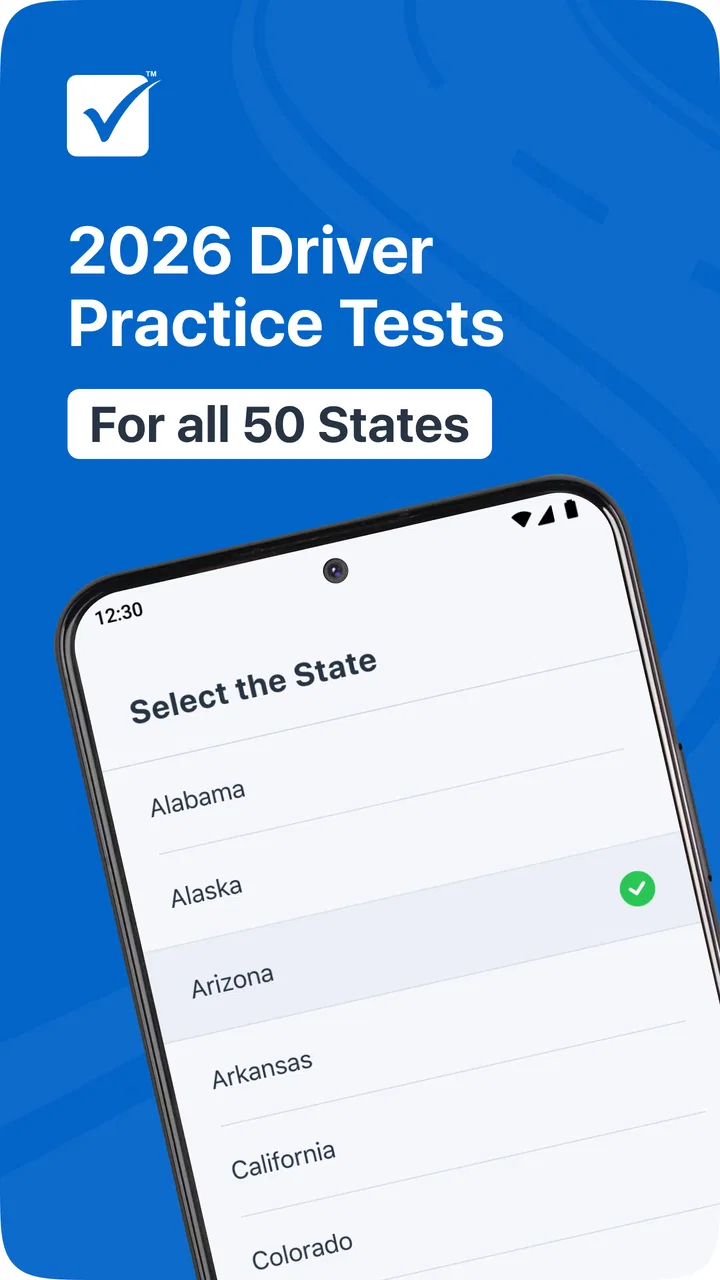
The short description, “Driver Test,” is not very revealing, but the broader purpose is clear once you use it. It is designed as permit practice test and driver-license preparation software, with coverage intended for all states and an additional focus on CDL preparation. That wide scope is useful for families or learners who move between states, but it also means you should pay attention to the state and license category you select rather than assuming every question applies to your exam.
I particularly like this format for learners who lose concentration while reading a handbook. A question forces a decision, and the explanation or correction gives the mistake a context. That active recall is more useful than highlighting pages and feeling productive without proving that the information stayed in memory. The app is also less intimidating than sitting down for a full mock exam immediately.
Still, the app should be treated as a practice tool, not as the legal authority for driving rules. The official DMV handbook for your state remains the place to confirm current wording, requirements, documents, restrictions, and procedures. The best approach is to use this app to identify weak areas, then verify important details against official material.
Why short sessions work better than random tapping
A realistic routine is to practice after a daily activity you already do. For example, if I had an appointment or a commute, I could complete a small set of questions while waiting, then write down only the topics that caused trouble. Later, I would review those topics in the handbook instead of repeatedly guessing until the app felt familiar. This prevents a common problem with quiz apps: memorizing the answer position rather than understanding the rule.
Another useful habit is to separate recognition from explanation. If I chose the correct answer but could not explain why the other choices were wrong, I would count that question as uncertain. That approach makes the app more demanding, but it gives a much more honest picture of readiness. It is especially important for questions involving exceptions, because road rules often depend on signs, road markings, weather, traffic conditions, or the type of vehicle involved.
The app is also a reasonable option for a parent helping a new driver. Instead of asking broad questions such as “Do you know the rules?”, a parent can ask the learner to explain a missed question in their own words. That turns a phone-based quiz into a conversation about safe decisions, not just a race toward a high practice score.
What the current version means for learners
The current version, 2.2.3, is the version I would evaluate when deciding whether to install it today. The app was released on February 2, 2020, so it has had time to establish a recognizable study format rather than appearing as a brand-new experiment. That history is reassuring in one sense: the product has remained available long enough to build a large user base and a strong average rating.
At the same time, a long-running test-preparation app has a responsibility to keep its material aligned with changing rules. A version number by itself does not prove that every state’s handbook has been updated recently. I would therefore use the app confidently for repetition and self-testing, while checking any rule that affects an actual exam or legal driving decision in the latest official source.
For an existing user, an update such as 2.2.3 is most valuable when it keeps the app usable and preserves a familiar study flow. I would not switch study methods just because the version number changed. Instead, I would compare the questions that appear in practice with the current handbook and watch for wording that seems outdated, overly broad, or different from the language used by the local DMV.
This is also where the app’s broad state coverage creates a trade-off. A national audience makes the tool more flexible, but a learner preparing for one exact state exam needs discipline. Select the correct state and license type, read explanations carefully, and do not assume that a general safety question carries the same legal meaning as a state-specific one.
Where it helps existing users most
If you have already started studying with the app, the most effective improvement is to stop treating every question equally. I would divide mistakes into three groups: facts I never learned, rules I confused with another rule, and questions where I rushed. Each group needs a different response. The first calls for handbook reading, the second calls for comparison, and the third calls for slowing down before selecting an answer.
A second practical technique is to revisit missed topics on separate days. Repeating a question immediately can create a false sense of mastery because the wording is still fresh. Waiting until later makes the recall test more realistic. If the same concept remains difficult, I would create a short note in plain language, such as “check the sign before deciding who has priority,” and then return to the official explanation.
The app is particularly useful near the end of a study cycle, when you want to discover gaps rather than read everything again. A handbook is better for learning the complete structure of the rules; this app is better for exposing the parts you cannot retrieve quickly. Used in that order, the two tools complement each other instead of competing.
For CDL learners, I would be more cautious about relying on practice alone. Commercial driving involves a larger body of knowledge and may involve separate sections or endorsements. The app can help organize review, but a learner should confirm that the exact CDL material needed for the scheduled exam is covered and current. A general permit candidate may find the app sufficient as a supplement, while a commercial applicant should use it as one layer in a broader plan.
Gaps and points of friction
The biggest limitation is not that practice questions are unhelpful; it is that multiple-choice practice can become too comfortable. Real exam questions may use unfamiliar wording, and real driving requires judgment rather than selecting one of several polished options. If you only repeat quizzes until the score feels good, you may be training recognition instead of understanding.
There is also a risk of overgeneralization. “All states” sounds convenient, but state rules are not interchangeable. A learner who moves quickly through questions without checking the selected jurisdiction could remember a correct rule for the wrong place. I would treat every state-specific answer as something to connect with the relevant handbook section, especially for penalties, restrictions, licensing steps, and unusual exceptions.
The app may also be less suitable for someone who learns best through diagrams, video demonstrations, or instructor feedback. A quiz can tell you that an answer is wrong, but it cannot replace seeing a complicated maneuver demonstrated or asking a teacher why a situation feels unsafe. If you are anxious behind the wheel, passing the written test will not automatically solve that problem.
Another limitation is motivational rather than technical. Practice apps make it easy to chase completion. A learner may answer quickly, see a result, and move on without examining the reasoning. I had to impose my own rule: no question counted as learned unless I could explain the answer without looking at the choices. That extra effort is important, and the app cannot enforce it for you.
People who already have strong driving knowledge may also find the experience repetitive. If you are renewing a license or reviewing familiar material, a focused official handbook check may be faster. The app earns its place when you need structured repetition, are starting from the beginning, or want a low-pressure way to find weak areas.
How it compares with the usual alternatives
The closest alternative is the official DMV handbook. That resource wins for authority and completeness, especially when you need exact legal language or procedural details. The app wins for convenience and retrieval practice. I would not choose one instead of the other: I would read the handbook to build the foundation, use the app to test recall, and return to the handbook whenever an answer affects an actual legal obligation.
In-person classes offer another kind of value. An instructor can explain confusing situations, adapt to a learner’s mistakes, and connect written rules to real traffic. That is better for someone who needs guidance or has trouble interpreting scenarios. The app is more flexible and private, making it a good supplement between lessons rather than a replacement for a qualified teacher.
Video-based courses can be stronger for visual learners. Watching lane positioning or defensive-driving examples may make a concept easier to understand than reading an answer explanation. However, videos are passive unless you stop and test yourself. The app’s advantage is that it makes you commit to an answer, which exposes uncertainty more quickly.
Other quiz apps may offer a more polished interface or narrower specialization, but the appeal here is its combination of permit preparation, state-oriented practice, and CDL-related study in one free education app. That broad purpose is convenient, though it increases the need for careful selection and official cross-checking. I would choose this app when I wanted breadth and repetition, not when I needed a complete driving course or personalized coaching.
Who should use it and who should skip it
I would recommend it to a first-time learner who wants a clear daily study routine, especially someone who finds a long handbook difficult to approach. It is also useful for a busy adult who can only study in short bursts, a parent supporting a teenager, or a learner who wants to diagnose weak areas before booking an exam.
I would be more reserved for anyone preparing for a specialized commercial exam without confirming the exact required material. I would also point learners toward a teacher or structured course if they struggle with reading comprehension, become overwhelmed by multiple-choice questions, or need help connecting written rules to real driving behavior.
The free price makes trying it low-risk, and the Everyone rating makes it broadly accessible for families. Even so, “free” should not be confused with “complete.” Your time is still valuable, so use the app with a specific goal: learn a topic, test it later, and verify important details. Endless random practice is less effective than a short, deliberate session.
What I would watch going forward
For a test-preparation app, future development matters most in the accuracy and freshness of its question bank. I would watch whether state-specific material continues to match current official handbooks, whether explanations clarify exceptions instead of merely marking answers, and whether CDL preparation remains clearly separated from ordinary permit study.
I would also look for improvements that support learning rather than decoration. Better ways to revisit missed concepts, clearer separation between state rules and general safety principles, and stronger guidance for interpreting mistakes would make the app more valuable without changing its basic quiz format. A visually attractive update would be less important to me than reliable content and a study flow that discourages guessing.
Existing users should keep their own notes when rules change. If a question conflicts with a newer official source, the official source should win, and the discrepancy is worth recording until the app reflects it. That habit protects you from carrying an old answer into an exam or, more importantly, into real traffic.
My final view is positive but practical. Driver Written Test: 2026 Test is a useful companion for building recall, finding weak subjects, and making permit study less passive. Its strongest use is alongside the official handbook, not in place of it. If you approach each question as a chance to understand a rule rather than simply collect a correct answer, the app can make preparation more organized and much easier to maintain.
I would install it for a learner who needs repetition and a convenient starting point, while setting clear boundaries around what it can do. It can prepare your memory for the written test; it cannot verify every current legal detail, teach practical vehicle control, or replace sound judgment. Used with those limits in mind, it is a worthwhile free study tool from DMV Written Test and a sensible addition to a careful driver’s preparation routine.
FAQs for Driver Written Test: 2026 Test
01What features does the Driver Written Test: 2026 Test app offer?
The Driver Written Test: 2026 Test app provides a comprehensive set of features, including state-specific practice tests, a detailed question bank, real-time progress tracking, and explanations for each answer. It also includes a simulation of the actual written test environment to help users prepare effectively for their driving exams.
02Is the content in the Driver Written Test: 2026 Test app up-to-date with current regulations?
Yes, the app regularly updates its content to reflect the most recent regulations and guidelines set by the Department of Motor Vehicles (DMV). This ensures that users are studying the most current information available, helping them to be well-prepared for their written exams.
03Can I use the Driver Written Test: 2026 Test app offline?
While some features of the app may require an internet connection, such as updates and certain interactive elements, the core study materials and practice tests can be accessed offline. This allows users to study anytime and anywhere without relying on a continuous internet connection.
04How customizable is the practice experience in the Driver Written Test: 2026 Test app?
The app offers a highly customizable practice experience, allowing users to select specific topics or sections they wish to focus on. Additionally, users can adjust the length of practice sessions and choose between different modes, such as timed tests or relaxed study sessions, to suit their learning style.
05Does the Driver Written Test: 2026 Test app provide support for multiple languages?
Currently, the app primarily supports English. However, there are plans to expand support for additional languages to accommodate a wider range of users. This enhancement will make the app more accessible and beneficial to non-English speakers preparing for their driving tests.
Pros
- Comprehensive question database.
- User-friendly interface design.
- Offline access available.
- Regular updates with new questions.
- Customizable practice sessions.
Cons
- Ads can be distracting.
- Limited free content.
- Some questions may repeat.
- No interactive learning features.
- Requires internet for full features.

Driver Written Test: 2026 Test
Gallery